If you run a holiday let, a guesthouse or a small hotel in the Algarve, Booking.com and Airbnb bring you guests who would never have found you on their own. They also take a slice of every stay, including the couple coming back for the third summer who already know the way to the beach.
The figures below come from the platforms’ own published pages, checked in October 2026.
What Each Channel Charges in 2026
Booking.com
Booking.com does not publish a single rate. Its partner page on commission says the percentage depends on your country, your property type and the agreement you signed when you joined. Booking.com charges it on the total booking amount: the room rate plus cleaning fees, service fees and any no-show or cancellation charges.
Join Preferred Partner or Visibility Booster and Booking.com adds percentage points on top of your base commission. Your real rate sits in your contract and in the reservation statements in the extranet.
Airbnb
Airbnb changed its model in 2025. Under the split fee, the host paid 3% and the guest paid 14.1% to 16.5% on top of the price. Airbnb is phasing that model out. Under the single fee, most hosts pay 15.5%, deducted from the payout, and the guest sees one price with no separate service fee.
The single fee is already mandatory for hosts who use property management software and for traditional hospitality listings such as hotels and serviced apartments. For a guesthouse or a small hotel, plan on 15.5%.
Stripe, for Direct Bookings
On your own site, a payment processor charges the guest’s card. Stripe’s pricing for Portugal is 1.5% + €0.25 per payment for standard European Economic Area cards and 2.8% + €0.25 for premium EEA cards. UK cards cost 2.5% + €0.25 and international cards 3.15% + €0.25, plus 2% if Stripe has to convert currency. There is no monthly fee: no bookings, no charge.
One Season in Numbers (Illustrative Example)
These figures are hypothetical and exist to show the arithmetic. Use your own.
Picture a villa that sells 20 weeks a season at €1,000 a week, cleaning included: €20,000 in bookings. For Booking.com we assume a 15% base commission with no extra programmes. For Stripe we count two payments per booking: a deposit and a balance, as in Casa da Avó’s 30/70 model.
| Channel | Cost on a €1,000 week | Cost over 20 weeks |
|---|---|---|
| Booking.com (15%, illustrative) | €150 | €3,000 |
| Airbnb (15.5% single fee) | €155 | €3,100 |
| Own site, Stripe with standard EEA cards | €15.50 | €310 |
| Own site, Stripe with premium EEA cards | €28.50 | €570 |
You won’t move all 20 weeks to your site in year one. A more realistic split: the platforms keep selling 14 weeks and 6 arrive through your site, from returning guests or people who found you on Google. On those 6 weeks you stop paying €900 in Booking.com commission and pay Stripe about €93. That leaves €807 on your side in a single season.
When a Direct-Booking Website Pays for Itself
With the example figures, each €1,000 week that moves from a platform to your site saves you between €120 and €140, depending on the channel and the card type. That gives you a rule of thumb: for every €1,000 the site cost to build, you need about seven to eight direct weeks at that price to earn it back. That might take one season or three. After that, each direct booking leaves you close to its full value.
Running costs count too. A CMS site with a booking plugin adds hosting, licences and updates, and that bill keeps arriving in the months when the house sits empty. For a property with a defined season, a site with no fixed costs earns back its build cost sooner. For build prices, read how much a website costs in Portugal in 2026.
What the Platforms Do Well
The commission pays for real work. Booking.com says it advertises properties on search engines in 45 languages and through more than 17,500 affiliate sites. A new house with no reviews and no Google presence reaches foreign guests through that reach. The platforms also give a guest who has never heard of you the comfort of booking through a brand they already use.
Leaving the platforms to save the commission tends to cost more than it saves. The best return comes from running both.
How to Run Both Channels
Platforms for Discovery
Let Booking.com and Airbnb bring in the first-time guest. Look after your reviews and photos, and sync the platform calendars with your site’s calendar so you never take a double booking.
Your Site for Guests Who Already Know You
A guest who enjoyed the stay searches for the property’s name on Google when they want to come back. If your site and your Google Business Profile show up first, they book with you. Work on local SEO for the property’s name and for searches like “villa with pool Praia da Luz”.
On direct bookings, the guest data stays with you. With the guest’s consent, you can email them in January with the summer dates still open.
Rules to Respect
Airbnb’s off-platform policy prohibits asking or encouraging guests to move current, future or repeat bookings off Airbnb. It also bans external links in listings or messages and discounts for booking elsewhere. Keep the listing and the messages for the current stay, and read your Booking.com agreement as well. Direct guests should reach you through your own channels.
The Casa da Avó Case
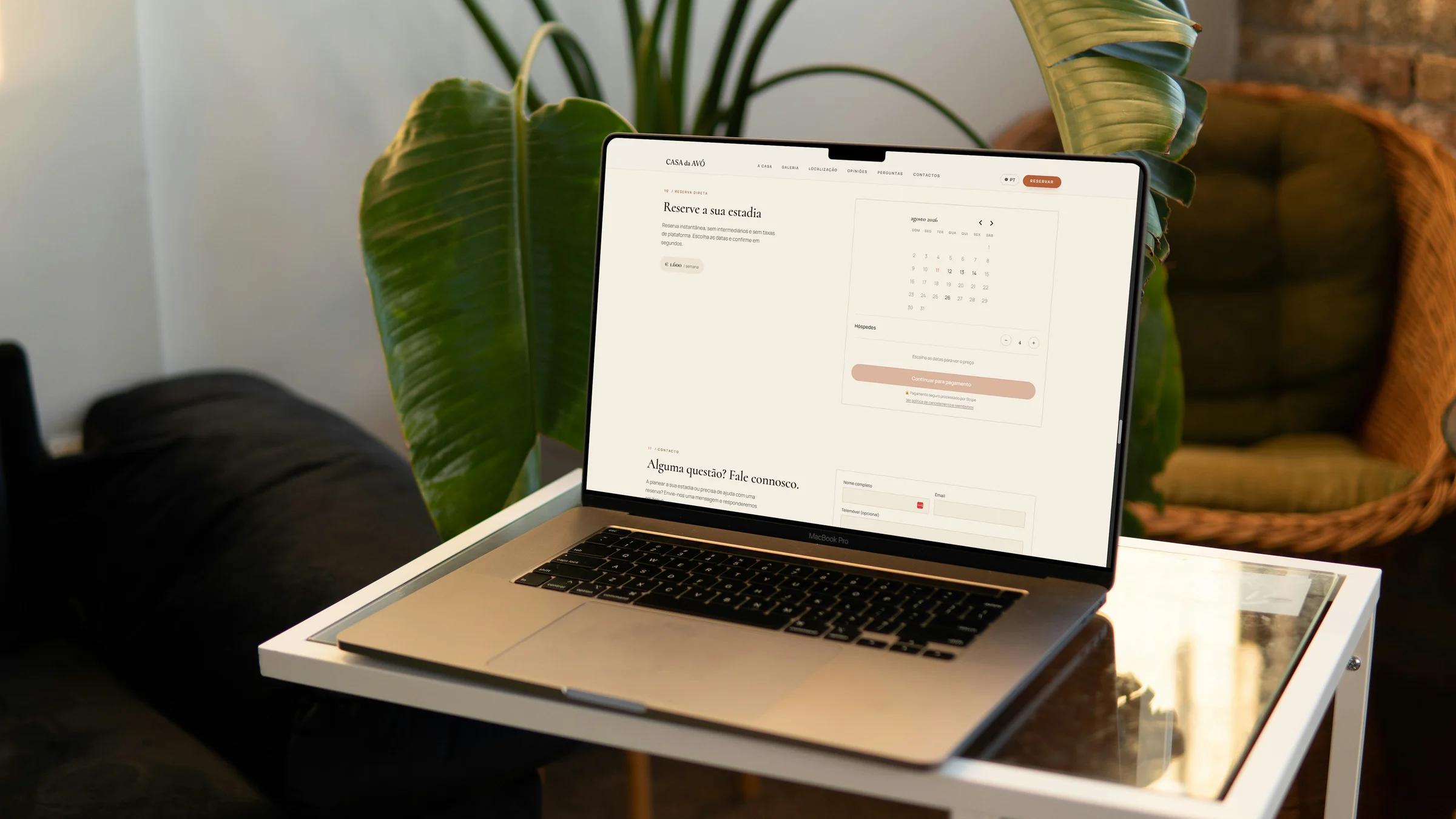
Casa da Avó is a private villa in Praia da Luz with three bedrooms, a pool and room for six, run by a family. We built it a direct-booking website with staged payments through Stripe. The guest pays 30% at booking to secure the dates, and the site charges the remaining 70% on its own 14 days before arrival. The family sends no reminders and chases no bank transfers.
The site has no CMS, no database billed by the month and no plugins. Its running cost is the domain, €2.80 a month. Stripe only charges when a booking comes in, direct bookings pay no commission, and the guest data belongs to the family.
Hotels and guesthouses with more rooms follow the same logic at a different scale. See our web design services for what we build for hospitality businesses.
Frequently Asked Questions
Should I leave Booking.com and Airbnb?
For most properties, no. The platforms bring new guests your site can’t reach yet. The aim is to shrink the share of bookings that pay commission while keeping that reach.
Can I take a deposit instead of the full amount?
Yes. Casa da Avó’s 30/70 model takes a deposit at booking and the balance before arrival, with no work on your part. Each charge pays Stripe’s fee on its own, which adds €0.25 to the booking.
Conclusion
Booking.com and Airbnb earn their commission when they bring you a new guest. When that guest returns, your own site keeps the booking for around 1.5% instead of the 15% in our example. In the scenario above, six direct weeks a season leave about €800 on your side. Run the sums with your own property’s numbers.
To find out what a booking website would cost for your property, try our quote calculator or get in touch.